Tag Archives: spirituality

Book Review from www.thebookrevue.com

by By Michael Beas

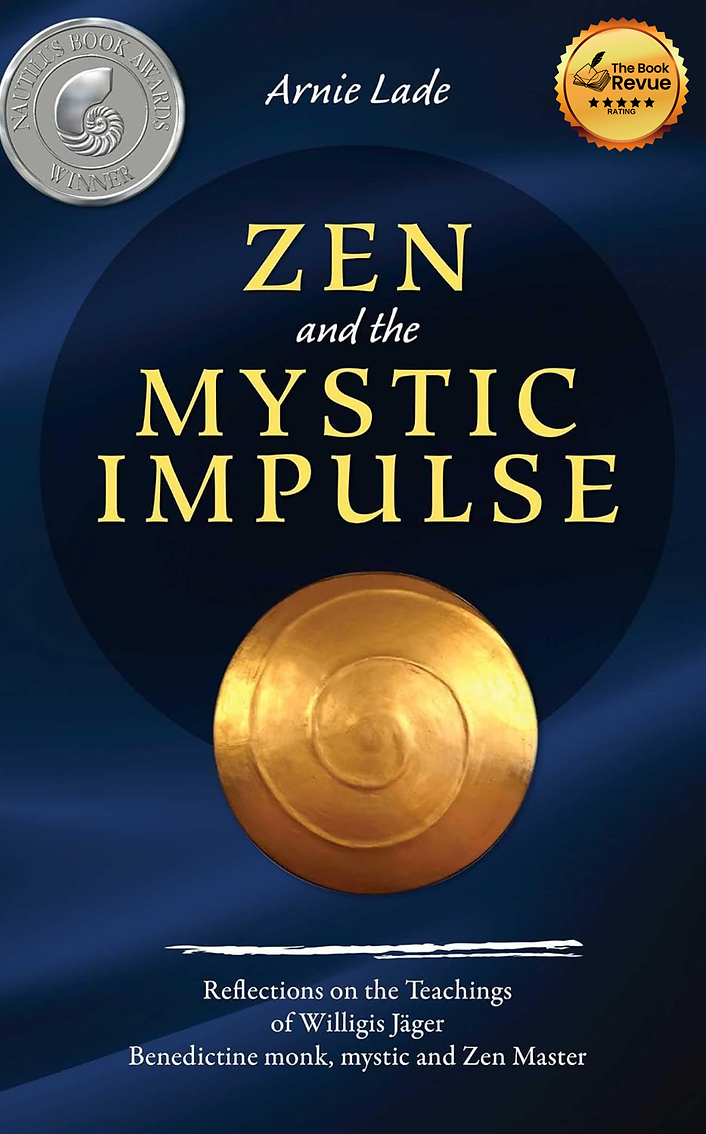
Arnie Lade spent fifty years practicing and teaching acupuncture and energetic healing, and somewhere in the middle of all that he encountered Willigis Jäger, a Benedictine monk, priest, and Zen Master whose teachings would quietly reorganize everything Lade thought he understood about spiritual life. Zen and the Mystic Impulse is his account of that encounter, and it is one of the most genuinely humble and luminous books in the current contemplative literature.

The figure at the center of the book is remarkable in his own right. Willigis Jäger was not a man who inhabited the boundaries between traditions; he dissolved them. A Catholic Benedictine and a fully authorized Zen teacher simultaneously, he spent his life pointing toward what he called the Sophia Perennis, the universal spiritual connection underlying all religious traditions. For Jäger, the mystic impulse was not the property of any particular faith. It was the deep human yearning for connection with something beyond the self, and it called to people regardless of the path they walked.

What makes Lade’s treatment of these teachings so trustworthy is the intimacy behind it. This is not a scholar writing about a subject. It is a student writing about a teacher who changed him, with all the specific, irreplaceable texture that kind of relationship carries. Richard Bryan McDaniel, author of The Story of Zen, called it deserving of a slow, reflective reading, and that assessment is exactly right. The book rewards patience. It is not trying to impress you. It is trying to create space, which is a considerably more difficult thing to do on the page.

At 133 pages, it does not overstay its welcome. Lade knows that the kind of wisdom Jäger embodied cannot be explained into someone. It can only be pointed toward, and he points with great care.

For anyone who has sensed that the mystic impulse exists in themselves but has never quite found a tradition that fully holds it, this book is a gentle and genuinely expansive guide toward that deeper belonging.

Moving Beyond Our Limited Selves

The spiritual challenge of our era is the urgent need for humans to free themselves from our collective ego tunnel. War, violence, greed, environmental damage, and inequality stem from the spiritual poverty and alienation caused by our ego’s dominance over us. Lessening the influence of our ego will allow us to strengthen our capacity for compassion towards ourselves and others.

Moreover, the ego’s natural feeling of separation only increases personal struggles like loneliness, despair, self-hatred, guilt, and shame. In turn, these struggles reinforce the illusion that we are separate from the world instead of connected to it. However, when we go beyond our limited egoic self, we can free ourselves from such suffering and move toward a more spiritually meaningful life. The path to this freedom is through cultivating awareness.

Awareness is not simply knowing that we know, as some may describe it. Pure awareness forms the ground of being beneath thoughts, feelings, sensing, and actions; a ground that extends beyond the limited self to encompass a larger reality beyond our individual identity. Such awareness has no object or subject — only what is, one that is both spacious and beyond words. Mystics refer to this ground of being as the true reference point of self, where utter emptiness and complete fullness coexist, along with a profound sense of belonging and love.

When we access pure awareness, even for a brief moment, we enter what mystics call the flow of immaculacy. Zen and mystical practices help us transcend our limited sense of self, ego, and personality, guiding us toward a broader reality where the feeling of separation and the illusion of the ego fade away.

All too often, awareness practices focus only on improving who we are—creating better versions of ourselves. While this is a noble and helpful goal, Zen and mystical traditions encourage us to go further, towards experiencing something greater than ourselves — call it what you will: the Unborn, the Tao. In Zen, we also practice manifesting this broader awareness into our daily lives. In Taoism, the sage Zhuangzi described this as the practice of self-forgetting—moving beyond our limited selves into a new way of being. And centuries later, Zen Master Dōgen reiterated this view, saying, “To study the Buddha’s Way is to study the self. To study the self is to forget the self. To forget the self is to be enlightened by all things.”

The following poem by David Whyte, an American poet and Zen Buddhist practitioner, encourages us to take this step, just beyond ourselves!

David Whyte, Just Beyond Yourself, from The Bell and the Blackbird.

Copyright © 2018 David Whyte. Reprinted with permission from

Many Rivers Press, Langley, WA. http://www.davidwhyte.com

Watch David Whyte read his poem in this video link:

https://davidwhyte.substack.com/p/just-beyond-yourself-c1b