All posts by arnielade

Book Review – Zen and The Mystic Impulse

by Charles Joerin,

Island Catholic Newspaper,

Volume 41  Issue 1,2,&3 | PostedApril 8, 2026

Introduction

The theme of Arnie’s book is encapsulated in its very title: being human is to have an innate desire, or impulse, to know the ineffable, that which lies behind the surface layers of all that we see with the “outer eye”.

Arnie expresses himself thus in Chapter 1:
In the depth of my being, there has always been a sense, a knowing, that there is something More, a Presence, something much greater than myself to which I am intimately connected.1

Full Disclosure

I have known Arnie Lade for twenty years, first as an acupuncturist, then as a friend, a fellow seeker of that which is unchanging AND accessible to all. So, yes, I may be biased in my praise of his book, but so be it. What you read here in this review, however, are my true reflections and assessment of the book.

Arnie shares his personal journey, filled with wonder, in this book. Truth be told, I hope for a future memoir that expands on his story and reflections begun in this book. Certainly, his road includes meeting the man he honours in the subtitle, Willigis Jäger, Benedictine Monk, Mystic and Zen Master.

I also note my friendship with the author, so you know you are reading a book written by a brother to us all, who treads a similar path. This, coupled with a style that immediately draws the reader into an almost familial relationship with the author, who, like us, is flawed and heroic, all wrapped up in the same person, makes for a swift uptake in wanting to read on.

In Arnie’s book, Zen and the Mystic Impulse, we are introduced to a ‘way in’ to recognizing the ‘More’ in our own lives. Many of us may already do so, and it is delightful to connect with what he says and to find ourselves responding, “Yes, that’s my experience too”. And if not, there is a kind and welcoming invitation to our own explorations.

I am reminded of the Christian scripture in which two unnamed disciples are walking on the road to Emmaus and encounter a person who walks with them and explains recent events in Jerusalem concerning Jesus of Nazareth. Upon arriving at Emmaus, the disciples ask the person to break bread with them, which he does. At this point in the story, the person is recognized as the same Jesus who was crucified:

Were not our hearts burning within us while he talked with us on the road and opened the scriptures to us?2

I like to think we have all experienced something like this, perhaps from a particular teacher at school, later from a friend, a spouse, a leader of a particular religion, or a great work of art. Like me, I think that Arnie Lade’s reflections and connections, written in this book, will, if not have your hearts burning, give you pause and perhaps some AHA! moments where things ring true for you because they make perfect sense and are so respectfully and humbly presented. Presented not to push any particular religion but to create the space where all are welcome, because we are all on the same road as the Emmaus disciples, possessed by the “mystic impulse” to connect to the ineffable, the never fully knowable ‘Other’.

A word about Zen might be appropriate since it is featured in the title of Arnie Lade’s book. Here he elaborates:

In Zen, this spiritual quest is called taking up the Great Matter of birth and death. This journey leads through the encounter of our most profound personal koans or questions at the crucible of all the paradoxes and dilemmas in one’s life, the ones that cannot be answered rationally…the answers lie in a transcendent experience – an experience that emerges spontaneously, that, by nature, is beyond the conditioned, rational self, out of which new perspectives and meanings emerge. In doing so, we can come to terms with life as it has been given to us in this existence, this place, and time. p17

Although Arnie employs Zen as the lens for his thesis, he by no means excludes others. In fact, one of the most appealing aspects of this book is that he encourages the reader to use their own lens, their own spiritual and religious vocabulary, to explain what is transpersonal, beyond any human construct. The author employs quotations from different traditions to make this point. The Mystic Impulse simply IS within us and therefore deeper than any allegiances we might have through life.

The subtitle of Zen and the Mystic Impulse is: Reflections on the Teachings of Willigis Jäger, Benedictine monk, mystic and Zen Master. Who was Willigis Jäger, and who was he to Arnie Lade? This is very much integrated into the book, although Arnie includes a short biography of Willigis Jäger in Appendix 1. In Arnie Lade’s Afterwords, he notes:

A quarter century ago, Willigis wrote,“Fundamental transformation of the world will never be achieved by a new social system, but only through the transformation of the individual … p117

I would conclude (and the book confirms) that Willigis was one of those who had a profound influence on Arnie’s transformation, which began many years before Arnie ever met Willigis. But this is how life is, is it not? If we are open to the spirit of transformation, people and events are offered to us, and when we take them seriously, we are transformed.

Conclusion

Let us conclude with a quote that honours the inclusivity found in both Willigis Jäger and the author, Arnie Lade, and that gives us an image we can carry with us on our own journeys of transformation:

One of Willigis’s frequently used analogies in describing the varieties of spiritual and religious experience throughout human history is that of light shining through stained glass, such as in a church. The pure sunlight diffuses and, at the same time, is tinted and tainted by the various colours, images and forms through the glass. Similarly, in mystical experiences, the individual expresses the one transcendent light (or reality) through their lived experience using words, images, songs and other unique intimations of their personality and conditioning. This conveys the inexpressible joy of breaking through into a whole new awareness. p17

Afterword:

I was active as a Roman Catholic priest on Vancouver Island for 12 years and am now retired. As a pre-teen, I lay in my bed asking, “Why am I here, rather than not here?” Truly, my life’s koan, the answer to which I get glimpses. An example was during Mass, when I gave the blessed bread and said “the body of Christ” to my parishioners. I felt something more than an emotion; it was an awareness that, as I gave the bread to each person, knowing much of their joys and sorrows, we were all truly one mystical body on the same journey, longing to know the answer to the same question I had asked myself so long ago. And yet today I do not have such a burning need to know the answer, but I do claim the mystical impulse to answer the answerable. And in the end, perhaps that is enough, simply to respond to the call of that perennial impulse propelling us into the mystic. I think this is the nub of what Arnie Lade is saying in this book.

And Finally:

A few words from Meister Eckhart, a 14th-century Dominican theologian whom some consider a mystic and who is read and referenced on several pages in Arnie Lade’s book. Here, on p. 116, the last page before Arnie’s Afterwords:

The most important hour is always the present moment, the most important person is always the one who is facing you right now, and the most necessary work is always love.3

I heartily recommend this book to you. You will wish to read it more than once, drawn by the author’s sense that you are the most important person in this moment. I think he wrote it as an act of love and respect, not only for his great teacher Willigis but also for you, the reader.

Zen and Mystic Impulse by Arnie Lade is available at local bookstores.

Footnotes

1 p.13 Zen and the Mystic Impulse. 2025
2 Luke 24:32 New International Version
3 Maria Kolek Braun Im Gespräch Sein (Holzkirchen, DE: Benediktushof Magazin-Online-Artikel) Internet source: https://www.benediktushof-holzkirchen.de/im-gespraech-sein/
Apprentice to Curiosity • Arnie Lade

At the bottom of this post, you can listen to a recent podcast interview I did with Michael Max for Qiological (www.qiological.com). In it, I explore a broad range of topics drawn from my experiences as an acupuncturist, healer, and writer. I hope you enjoy it!

Michael writes: “In this episode, I get to sit for a conversation with Arnie Lade. He’s the author of a book I spent a lot of time with in the library when I was in acupuncture school. Acupuncture Points: Images and Functions wasn’t a book I read to pass exams; it was one I read to get a feeling for points.

We explore how the work of Moshe Feldenkrais has influenced his work. And how both learning and healing often enough requires an element of unlearning. How ‘not-knowing’ is the beginning of fruitful inquiry. That even good diagnostic models can become a box if you cling too tightly. 

One of the things we touch on that is not often discussed in our trade is the later years of a career and what it’s like to step away from a lifetime of practice. I used to hold a romantic notion of practicing until the end of my days. I’m glad there are people like Arnie a few steps ahead to point out the landscape that I’ve imagined, but not accurately mapped. 

Finally, we touch on his latest book Zen and the Mystic Impulse, it’s a reflection on the time spent with his teacher, his own experience of practice, and the intimacy of not-knowing. Which, curiously enough, is the polar opposite of this first book I read all those years ago on the intimacy of ‘knowing’ a point, instead of relying on memorized function. “

Moving Beyond Our Limited Selves

The spiritual challenge of our era is the urgent need for humans to free themselves from our collective ego tunnel. War, violence, greed, environmental damage, and inequality stem from the spiritual poverty and alienation caused by our ego’s dominance over us. Lessening the influence of our ego will allow us to strengthen our capacity for compassion towards ourselves and others.

Moreover, the ego’s natural feeling of separation only increases personal struggles like loneliness, despair, self-hatred, guilt, and shame. In turn, these struggles reinforce the illusion that we are separate from the world instead of connected to it. However, when we go beyond our limited egoic self, we can free ourselves from such suffering and move toward a more spiritually meaningful life. The path to this freedom is through cultivating awareness.

Awareness is not simply knowing that we know, as some may describe it. Pure awareness forms the ground of being beneath thoughts, feelings, sensing, and actions; a ground that extends beyond the limited self to encompass a larger reality beyond our individual identity. Such awareness has no object or subject — only what is, one that is both spacious and beyond words. Mystics refer to this ground of being as the true reference point of self, where utter emptiness and complete fullness coexist, along with a profound sense of belonging and love.

When we access pure awareness, even for a brief moment, we enter what mystics call the flow of immaculacy. Zen and mystical practices help us transcend our limited sense of self, ego, and personality, guiding us toward a broader reality where the feeling of separation and the illusion of the ego fade away.

All too often, awareness practices focus only on improving who we are—creating better versions of ourselves. While this is a noble and helpful goal, Zen and mystical traditions encourage us to go further, towards experiencing something greater than ourselves — call it what you will: the Unborn, the Tao. In Zen, we also practice manifesting this broader awareness into our daily lives. In Taoism, the sage Zhuangzi described this as the practice of self-forgetting—moving beyond our limited selves into a new way of being. And centuries later, Zen Master Dōgen reiterated this view, saying, “To study the Buddha’s Way is to study the self. To study the self is to forget the self. To forget the self is to be enlightened by all things.”

The following poem by David Whyte, an American poet and Zen Buddhist practitioner, encourages us to take this step, just beyond ourselves!

David Whyte, Just Beyond Yourself, from The Bell and the Blackbird.

Copyright © 2018 David Whyte. Reprinted with permission from

Many Rivers Press, Langley, WA. http://www.davidwhyte.com

Watch David Whyte read his poem in this video link:

https://davidwhyte.substack.com/p/just-beyond-yourself-c1b

Winter 2026 ATM Classes

Greetings, friends, and I hope your holidays have been restorative. As we welcome 2026 and the return of more light!

Classes will be starting Monday, January 12th! Hope to see you then, live or on Zoom!

Live classes on MONDAY Mornings at 11:00 AM – 12:OO noon

Online Zoom classes are on MONDAY Afternoons at 4:30 – 5:30 PM

All classes run until February 23rd, 7 classes in total.

One other admin detail; please correspond, register and pay through this email address: adlade@shaw.ca

I look forward to continuing our explorations and awakenings together!!

Diane Lade

Arnie’s New Book

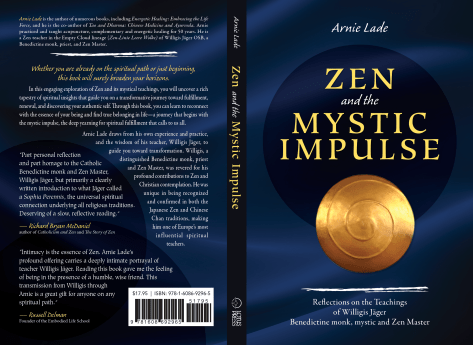
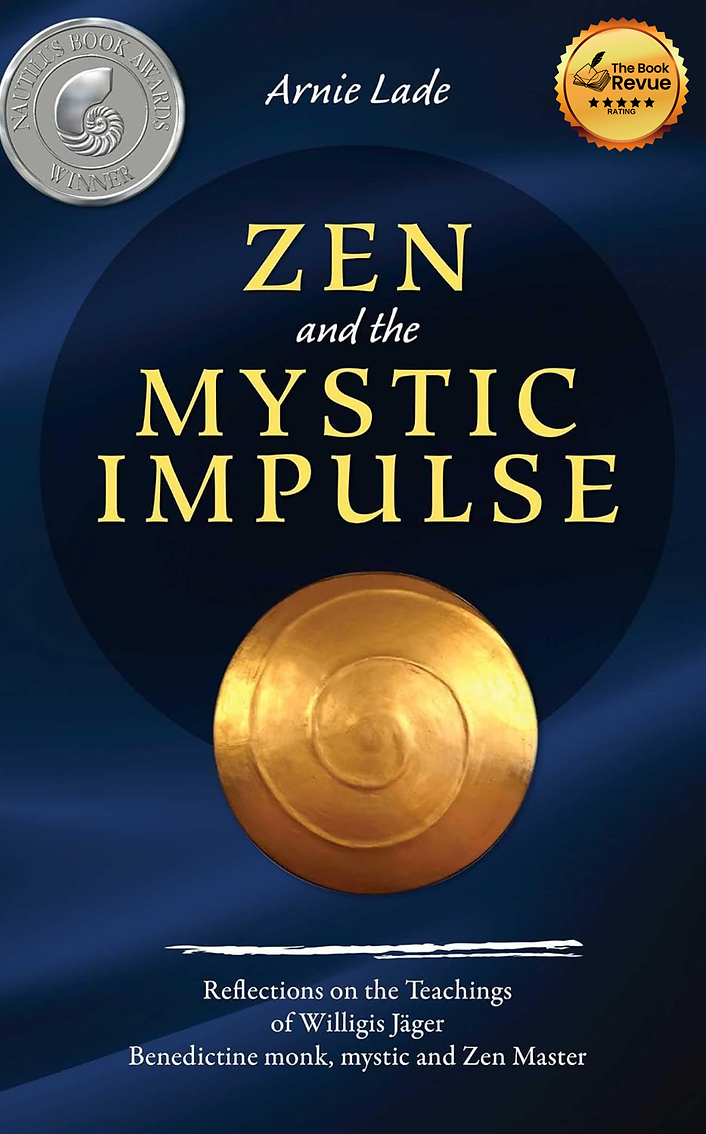
I am excited to share that my new book, Zen and the Mystic Impulse, has been published and is now available for purchase.

This project has been a labour of love and a tribute to my Zen teacher, Willigis Jäger, as well as my spiritual journey over the past fifteen years. Willigis (1925-2020) was a distinguished Benedictine monk, priest, and Zen master, renowned for his significant contributions to Zen and Christian contemplation. He was unique in being recognised and confirmed in both the Japanese Zen and Chinese Chan traditions, making him one of Europe’s most influential spiritual teachers of his time. 

In this captivating exploration of Zen and its mystical teachings, I hope you will discover a rich tapestry of spiritual insights that can guide you on a transformative journey toward fulfillment, renewal, and the discovery of your authentic self. Whether you are already on a spiritual path or just starting out, I believe this book will broaden your horizons. As I mention in the introduction, “Mysticism is the path of transformation that leads to fulfillment, renewed meaning, and the realization of an authentic, whole person. This journey is achieved through the rediscovery and connection to the foundation of one’s being and by finding true belonging in life to something greater than oneself.”

Zen and the Mystic Impulse can be ordered online on both Amazon.ca and Amazon.com   ISBN 978-1-6086-9296-5 

It is also available directly from my publisher, Lotus Press

Locally, here in Victoria, BC, both Bolen Books and Russell Books are now stocking my book!

With warm regards

Arnie Lade

From Reviews:

“Intimacy is the essence of Zen. Arnie Lade’s profound offering carries a deeply intimate portrayal of teacher Willigis Jäger. Reading this book gave me the feeling of being in the presence of a humble, wise friend. This transmission from Willigis through Arnie is a great gift for anyone on any spiritual path.”

— Russell Delman, Founder of the Embodied Life

“Part personal reflection and part homage to the Catholic Benedictine monk and Zen Master, Willigis Jäger, but primarily a clearly written introduction to what Jäger called a Sophia Perennis, the universal spiritual connection underlying all religious traditions. Deserving of a slow, reflective reading.”

— Richard Bryan McDaniel, author of Catholicism and Zen and The Story of Zen

“When the world seems to fall apart, it’s even more important to be well-rooted. Zen and mystical practices have the ability to access the deeper layers of human existence and to both energize and calm our souls. This, however, requires experienced guidance as provided by Arnie Lade through his insights and reflections on the teachings of Willigis Jäger, a modern-day Christian mystic and Zen Master.”

— Dr. Christoph Quarch, Philosopher and author

Time, Rhythm & The Twelve Hours of the Day

As the seasons change, I would like to share some observations on the ancient Chinese understanding of the rhythms of nature, especially the seasons and the hours of the day, and how they affect our lives and health.

To the ancient Chinese, the idea of time was entirely based on observing nature. In particular, the rhythms of the day, the four seasons, and the celestial abode (moon, stars, planets, comets, eclipses, etc.) all had significant meaning and importance. Humanity and the universe were one, and time had an endless, repetitive quality. About time, Confucius is reported to have said, sitting by the river, “It is what passes like that, indeed, not ceasing day or night.”

 Astronomy was a very early and serious profession. The Royal courts of the various dynasties had an “Official of the Fire Star.” The Fire Star is the name of the constellation Scorpios, carved in China’s earliest astronomical records, the Oracle bones, more than 3,500 years ago. The star was symbolized by a winged phoenix (or sometimes a dragon) and associated with the Emperor.

The court astronomers, who were also astrologers, created calendars for the Emperor to safeguard his reign so that coming events could be foretold (such as natural disasters, famines, wars, weather and so forth). In this way, the Emperor might influence the events as they unfolded, avoiding blame for the catastrophes since these things reflected poorly on his “Mandate from Heaven.”

To the ancients and still today, human life was understood as being governed by predictable patterns or cycles. The most important and longest is the grand 60-year cycle. During this period, the individual’s emotional, mental and spiritual life is expressed in more minor rhythms, especially the 12-year cycle of Jupiter and the 30-year cycle of Saturn, which are important “seasons” in the individual’s life. This patterning forms the basis of modern Chinese astrology.  Understanding when life’s Qi (or energy) gets stagnant or blocked in life’s journey can give us insights into the appropriate course of action. Practically, in Chinese medicine, this might include using various forms of what I would call spirit acupuncture to harmonize the heart/mind.

 Also important were the moon phases, which had a steady ebb and flow of lunar light throughout the month. It was observed that specific changes occurred within nature and human beings during a lunar cycle. The ancient people harmonized themselves with the lunar Qi (or energy), thus helping them plant crops, treat illness, and harvest the seas and rivers using tidal patterns and so forth. For example, the drawing or loss of blood (which occurs in surgeries) on the full moon was considered inauspicious and dangerous, which could lead to unwanted complications.

 Likewise, the four seasons were critical to the early Chinese. In particular, the beginning of each season was marked by festivities linked to ordinary people’s agricultural life. Very early in the Shang Dynasty Book of History (written sometime before the 12th century BCE), it was observed that the four meridian “stars” (Hydra, Scorpios, Aquarius and the Pleiades) marked the beginning of the seasons. These stars were seen due south at dusk on the equinox and solstice. People naturally regulated their sleep, eating habits, clothing, planting and harvesting times and so forth to the endless progression of the seasons.

Traditionally, the transitional periods of two or three weeks before the solstice and equinox were considered auspicious times for fasting, prayer, and therapy (such as acupuncture, herbs, or dietary changes) to prepare oneself for the coming season. During these times, one can prevent and treat seasonal disorders before they arise. For example, seasonal allergies (such as pollens in the springtime) can be significantly alleviated, if not entirely prevented, by treatment at the appropriate time just before the season in which they occur.

Daily life was also guided by the natural rhythms of sunrise and sunset, midday and midnight. In the local villages, temple bells and gongs marked the important hours. In the bustling cities, the hours of the day were punctuated by gongs & trumpets during the day and by the beating of drums at night. For example, the guards of the city gates would play their loud trumpets and gongs to announce the closing of the four gates at sunset.

The day was divided into twelve hours (corresponding to two of our modern hours). These hours are linked to the natural divisions of sunrise, sunset, midday and midnight. 

 Such was the fascination and need for accurate timekeeping that the Chinese invented (much earlier than in the West) various forms of mechanical timekeeping (such as the water clock) to keep track of the hours. However, more commonly at home or in the temples, the hours were marked by the burning of incense sticks that lasted almost exactly the Chinese hour. Work, sleep, rest, meals and the various activities of life were harmonized to these hours, but there was also a more profound significance to these divisions, health-related connections. The twelve hours were observed and linked to the various Organs and the Meridian Qi of the body. 

 According to Chinese medicine, the human body has twelve major organs connected to the twelve Meridians in which Qi, or vital energy, flows.  The Meridian system is a unique feature of Chinese medicine that distinguishes it from other healing systems. The ancient Inner Classic (5th century BCE) states – “The Meridians move the Qi and Blood, regulate the Yin and Yang, moisten the tendons and the Bones, benefit the joints…. Internally, the meridians connect with the organs; externally, they connect to the body’s joints, limbs, and outer surface.” The ancients perceived a whole network of subtle three-dimensional pathways linking and regulating the various structures and Organs of the body. Furthermore, the Qi moves in a fixed circuit through the organs and meridians daily.

The twelve Organs were seen as representatives or “Officials” that embraced the mind-body. Each organ is related to an emotion, season, direction, time of day, virtue, bodily tissue and substance, sense organ, planet, taste, etc. For example, the lungs were given the image of a Judge guided by fairness (its virtue), related to the autumn, grief, tears, the direction west, and so on. All these associations are ancient observations brought together in the 5th century BCE as a unifying theory called the Law of the Five Phases (sometimes referred to as the Five Elements).

Now, back to the twelve hours. In my book Energetic Healing: Embracing the Life Force, I have written: “Chinese medicine and modern biomedicine agree that the organs have biological rhythms. These rhythms are marked by periodic, fluctuating levels of organ activity during different times of the day. Functional or circadian rhythms have been known to Western science, especially in investigating syndromes related to rapid long-distance travel, wherein the body’s biorhythms become disturbed. Circadian means “time periods in a day” and refers to biological processes that occur regularly within a twenty-four-hour time period.

In Chinese medicine, the various biological rhythms of the organs are reflected through and harmonized by the Meridian system… I have found that this knowledge of organ rhythms can illuminate illnesses that follow predictable patterns. For example, insomnia, in which a person consistently wakes up around 3 o’clock in the morning, is usually due to an energetic blockage between the liver and lungs, while a collapse of physical and mental vitality after lunch, around 1 or 2 o’clock in the afternoon, is usually due to a small intestine problem.

Other associations and observations that I have noticed in my life and practice are that the longer a person stays up past 11 pm, the harder it becomes to fall asleep due to increasing gallbladder/liver energy; the best time for a bowel movement is in the early morning when it’s the large intestine time; more heart attacks occur around midday than any other time of day; the morning meal is usually the easiest to digest grains due to the stomach and spleen-pancreas influence, while the noon meal is better for complex meals as 1 pm begins the small intestine’s hour of influence. Another typical pattern is the late afternoon feeling of tiredness and collapse (often due to stress and overwork) linked to the Kidney Qi’s time of day. This is but a small sampling of the patterns that the knowledge of our biorhythms has shown us.

In practice, the knowledge of the organ clock is beneficial in choosing the optimal appropriate time for treatment, whether it be with herbs, drugs or acupuncture. 

The chart below shows the twelve-day divisions with their organ-meridian correspondences.

I hope this brief article has given insight into life’s various cycles and how one can benefit from knowing its ebbs and flows. 

For more information, please consult a traditional acupuncturist.

On Turtles

I frequently walk past King’s Pond on the north end of Cedar Hill Golf course, stopping to enjoy the interesting variety of birds congregated in and around the pond, including mallards, wigeons, wood and ring-neck ducks. When the weather starts to warm up during spring another resident of King’s Pond starts to reappear, the turtle. On a sunny day, I often see 7 or 8 of them lined up on the log float that’s anchored in the middle of the pond. The turtles are lazily sunbathing and warming themselves, sometimes with one turtle half resting on its neighbour in a friendly fashion. The other day I took a photo of one turtle who decided to sit on a rock near the foot path. Turtles usually bring a smile to my face whenever I see them.

This got me thinking about turtle lore in ancient China and how they were used and still used in traditional Chinese medicine.